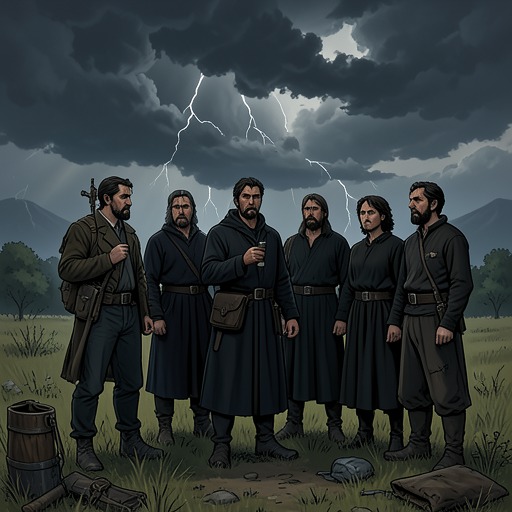
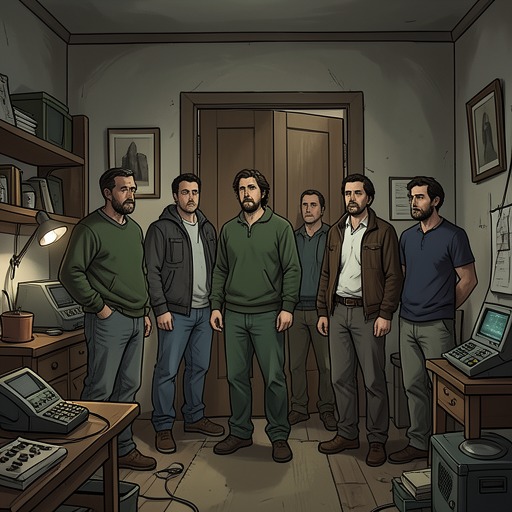
“I would watch the world die a hundred times over”
The Cabin at the End of the World“I would watch the world die a hundred times over” is Andrew’s declaration of refusal when Leonard demands that his family choose one of its three members to die in order to avert the apocalypse. The expression’s force lies in its conditional opening and absolute conclusion: even if Andrew accepted the proposed stakes, he would not agree to the sacrifice.
The Statement and Its Context
Leonard presents the choice as a command delivered through a vision shared by four strangers who, he says, received the same message at 11:50 p.m. the previous Monday. He tells Andrew, Eric, and Wen that one of them must be willingly selected and killed; otherwise, the rest of humanity, more than seven billion people, will perish. The three captives would survive, but Leonard says they would witness the end and be left alone in the devastated world.
The ultimatum is not offered under conditions of ordinary consent. Andrew and Eric are restrained, Wen hides behind Andrew’s chair, and Leonard says the family must remain in the cabin until it chooses or its time runs out. He promises the intruders will not hurt them further while requiring them to consider killing one another. Against that combination of captivity, a threatened global catastrophe, and a claimed deadline, Andrew’s words reject the premise that the demanded act can become acceptable simply by being called necessary.
The Meaning of the Refusal
Andrew begins by allowing the hypothetical for the sake of argument: even if he believed the world were at stake, he says, he would still refuse. That distinction matters. The statement does not confirm that Andrew believes Leonard’s account; it makes his refusal independent of that uncertainty. He will not trade Eric or Wen for the promised salvation of the world, even in the scenario Leonard insists is true.
The scale of the hyperbole—watching the world die a hundred times—sets the magnitude of the choice against the intimacy of Andrew’s commitment. Leonard speaks in terms of humanity as a whole and presents the family as responsible for its survival. Andrew answers from the position of a husband and father: the threatened world does not make his family expendable. The expression turns a supposedly rational calculation into a declaration of loyalty.
Form and Emotional Force
Andrew does not finish the sentence. He stops after the word “before” because he does not want to complete it. The break leaves the thought suspended, but not the decision: the unfinished clause sharpens rather than softens his refusal. Its restraint contrasts with Leonard’s increasingly impassioned account of cosmic isolation and with the enormous consequences he places on the family’s response.
The scene also complicates Andrew’s defiance. He knows that feeling strong and loving Eric does not free him from the chair or remove the intruders. His words are therefore neither a practical escape plan nor proof that the danger has passed. They are a clear statement of what the captors cannot make him choose willingly.
Later Resonance
The expression gains weight as the captives face the choice again. Leonard describes the next opportunity as a gift and sets it for the following morning, while maintaining that delay brings the world closer to permanent midnight. Eric later tries to prolong the conversation by asking Adriane about her former restaurant work, a small effort to keep the group talking instead of forcing an immediate decision. These moments extend the conflict Andrew’s statement defines: the intruders call the choice selfless, but the family continues to resist the demand.
Later, Sabrina lays out the sequence the intruders use to reinforce their claim: after Redmond dies, an earthquake and tsunami strike; after Adriane dies, bird flu spreads. She counts down the remaining members and warns that further deaths will bring further calamities. This account makes the choice’s pressure more concrete, but it does not erase the distinction in Andrew’s original statement between believing a threat and accepting its prescribed sacrifice. When Andrew later asks Eric directly whether he thinks one of them has to be killed by the other to keep the world from ending, the question shows that the conflict remains unresolved between them. The earlier expression endures as a measure of Andrew’s limit: no promised outcome makes his family a willing offering.